The Sovereign African Learning Infrastructure
Beyond screens and apps: A vision for high-fidelity, edge-AI educational proxies in the 200-seat lecture halls of Nigeria and beyond.
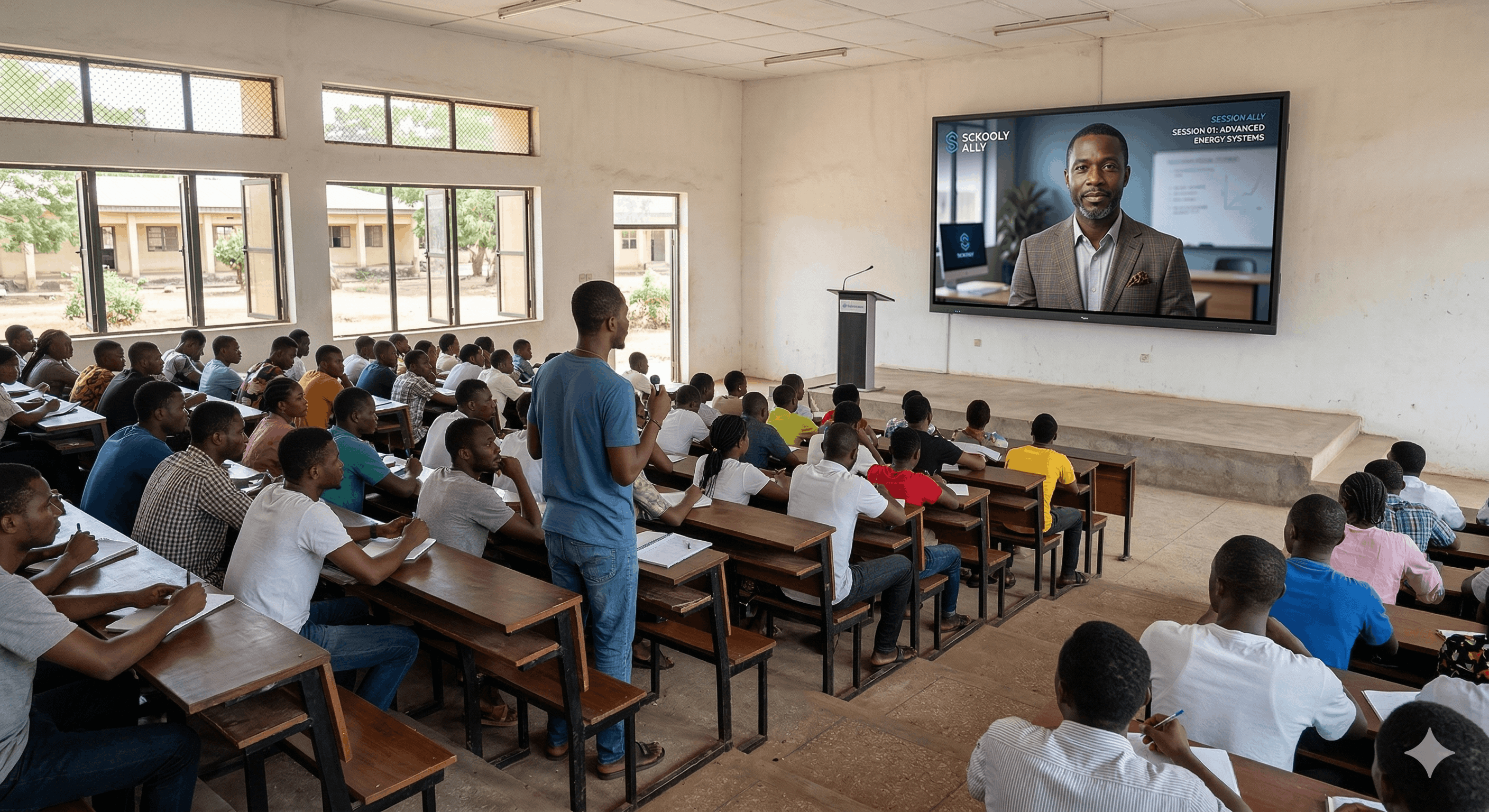
Visualization of the Sckooly Edge-AI Infrastructure in a Nigerian university lecture hall.
Abstract: The 200-Seat Dilemma
We are standing on the precipice of a massive shift in how education is delivered. In the West, AI in education often focuses on "privacy-first," passive, app-based tools. However, the African reality is drastically different. In high-stakes educational environments in Nigeria, such as our public universities, the core issues aren't just about curriculum quality - they're about delivery scale, physical logistics, and systemic gatekeeping.
Imagine walking into a classroom of 200 students. At the front of the hall, instead of an exhausted or absent human lecturer, there is a hyper-realistic, life-sized AI tutor answering questions in real-time, responding to the mood of the class, and delivering nuanced material perfectly. She never misses a 7 AM class and never goes on strike. This is not science fiction; the tools to assemble this reality are already here. Sckooly V2.0 is transitioning from an already established mobile learning ecosystem into the underlying Operation System for the African University.
Core Thesis: We aren't just building another AI wrapper; we are building physical-digital sovereign infrastructure to bypass poor internet, unpredictable power, and the high marginal costs of third-party API dependencies.
The "Centaur" Model: High-Fidelity Proxy System
One of the largest hurdles to educational innovation in Nigeria is institutional friction. Many lecturers might perceive an autonomous AI teacher as a direct threat to job security. To solve this, Sckooly V2.0 embraces the "Centaur" approach: combining human strategic oversight with the AI’s infinite patience and execution. Without the lecturer, the AI instance cannot function. This solution does not take away jobs; it improves learning outcomes and lets lecturers focus on high-level academic oversight.
The Director and The Performer
In our architecture, the lecturer does not disappear; they are elevated. The lecturer becomes the "Director" and the AI becomes their high-fidelity "Performer."
- The Blank Instance: We do not fine-tune the AI preemptively. Instead, Sckooly provides a powerful, blank AI instance to each school and each lecturer.
- Lecturer-Driven Data: The lecturer feeds their specific instance with their exact syllabus, proprietary research papers, and course materials for that semester. Since teaching styles vary (e.g., Unilag vs. Uniben), an AI instance deployed in one school is specifically tailored to that school's curriculum.
- The Sckooly App Ecosystem: Sckooly is already established as a comprehensive mobile learning ecosystem - powering digital campuses, instant connections, and smart hybrid learning. This new V2 infrastructure builds directly on top of that system. Lecturers configure their AI proxies via our Desktop Application, and the live classroom sessions are broadcasted directly to massive Smart TVs in the lecture halls using the Sckooly TV App. Concurrently, students use their existing Sckooly Mobile App to view instant notes, engage with quizzes, and manage their academic journey remotely.
The System Assembly: Multimodal Edge AI
Sckooly V2.0 is not waiting for a miraculous technological breakthrough; it relies on System Integration. The components for human-level interactive proxies already exist. Our innovation lies in the orchestration layer - the glue that makes the hardware and software communicate with sub-100ms latency without relying on the cloud.
The Brain: Local LLMs
Powered by open-source LLMs (like Llama 4 Scout or Qwen 3.5) with 10M+ token context windows running locally on heavy GPU edge servers. They can process entire syllabi dynamically without losing context.
The Voice: YarnGPT
To cross the cognitive gap, the AI must sound like its students. We utilize YarnGPT, an architecture specifically tuned for Nigerian accents (English, Yoruba, Igbo, Hausa).
The Eyes: Computer Vision
Using YOLOv11 and edge-heuristics via ceiling mics to handle spatial processing. The AI dynamically pauses if classroom noise exceeds 60dB or maps student attendance via face-matching in real-time.
The Body: 3D Avatars
A high-res video stream is too heavy to generate locally. Instead, a rigged 3D Avatar (powered by Unreal Engine) lip-syncs dynamically to the YarnGPT audio stream, reducing inference latency significantly.
The Orchestration Layer
The true IP of Sckooly V2 is the "Interrupt Logic." This is the orchestration code that continuously bridges these systems. It determines when the AI pauses to listen to a question caught on a room mic and dynamically references the exact PDF the lecturer uploaded that morning to generate an accurate response - all happening in near real-time.
Economics & Sovereign Infrastructure
To survive in the African market, technology must be insulated against systemic failure: currency fluctuation, power grid capsizing, and poor bandwidth backhaul. Sckooly provides this by shifting from SaaS to "Infrastructure as a Service" (IaaS).
The Sckooly Edge Box
We deploy high-end customized computational nodes directly to the university campuses. Rather than putting a GPU in every classroom, we place one powerful node (equipped with NVIDIA RTX 5090s) in the faculty building. This node serves as the "Sovereign Brain" for surrounding lecture halls.
Because the inference is completely localized - utilizing quantized open-source models - our marginal API costs drop to zero. We do not pay global server farms for compute tokens. Furthermore, these faculty nodes run entirely on off-grid solar rigs (inverters and lithium storage) to become immune to power outages.
The Financial Model
Universities subscribe to a yearly flat-rate hardware and maintenance contract. This replaces the unpredictable costs of scaling physical lecture logistics and immediately upgrades their infrastructure, allowing them to provide world-class, consistent educational quality to remote and resource-strapped locations via a simple, high-gain localized campus mesh network.
Building the future of African Education. © 2026